
Establish finished levels
Relate proposed heights to buildings, boundaries and drainage. Clarify the purpose of each area rather than aiming for flatness everywhere.
✦ LANDSCAPING · LONDON & NEARBY
An uneven garden can make the intended layout difficult. Photographs of the levels, surrounding edges and access help define the work before a quotation.
Trading since March 2015 · Edgware based · Homes & businesses
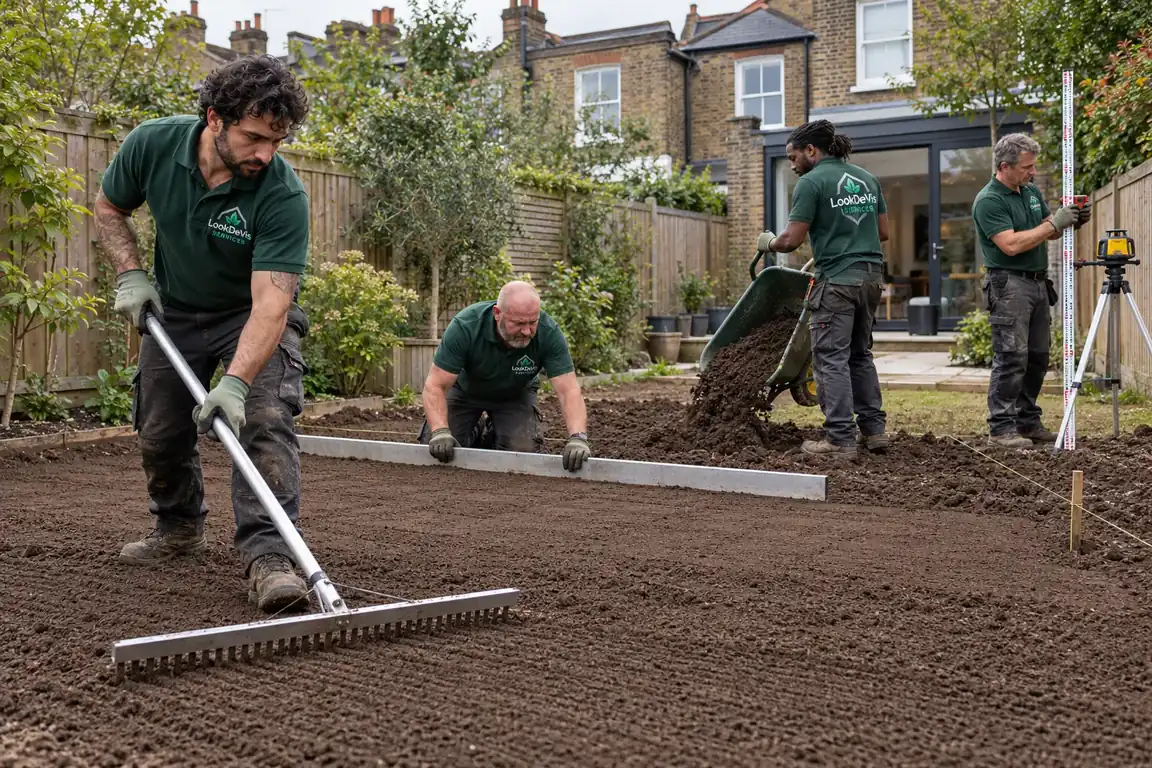
Point out the areas that are awkward to use and explain whether you are planning turf, artificial grass, paving or another finish. Existing concrete, foundations and changes in level can affect the amount of work. We discuss the ground preparation with the intended use of the space so the quotation describes an agreed job. Work beside paths, steps, fences or neighbouring land needs a clear scope rather than an assumption that every adjoining feature will be altered.
The scope should identify excavation or imported soil, suitable compaction and the final growing or construction layer. Groundworks form part of this preparation rather than an unrelated standalone page. Hidden rubble, soft pockets or unsuitable fill may need additional investigation. Where a change of level creates a bank or retained edge, the support must be assessed. Existing drainage, damp-sensitive building details and buried services constrain what can safely be changed.
Relate proposed heights to buildings, boundaries and drainage. Clarify the purpose of each area rather than aiming for flatness everywhere.
Agree excavation, suitable fill and compaction where needed. Identify the surface layer separately from underlying preparation.
Assess whether steps, retaining edges or drains are required so the level change works with the rest of the garden.
Send your postcode, measurements and photos taken across the slope, not only from above. Explain whether the finished area will be lawn, paving, planting or another surface. Identify access for material movement and any previous ground works. The quotation should distinguish removal, imported materials, retaining requirements and the final surface.
Structural retaining design, major drainage and new surface installation are separate unless included explicitly. Small lawn depressions may be suitable for lawn restoration rather than full garden excavation.
✦ BEFORE YOU BOOK
The achievable layout depends on height differences, boundaries, drainage and support. Terracing may be more appropriate than one flat surface.
Only if stated in the quotation. Earth movement and soil preparation are distinguished from supplying and laying the finished lawn.
Smaller depressions may suit targeted lawn restoration. Larger or recurring dips need assessment of the underlying cause.
They can. Water routes should be assessed before changing the ground, especially beside buildings and boundaries.
Removal arrangements and quantities are agreed separately. Site access and the material found affect disposal planning.
✦ RELATED TASKS
Your postcode and current photos help define the scope before we agree a quotation and appointment.